Running on Rust: The True Cost of Aging Mill Equipment and the Case for a Smarter Capital Strategy
There is a particular kind of institutional inertia that takes root in timber mills. A band saw that has been running for two decades becomes, in the minds of operations staff, a known quantity—its quirks understood, its failure modes anticipated, its rhythms absorbed into the muscle memory of the floor crew. Replacing it feels disruptive. Keeping it feels prudent. But in an era of tightening margins and accelerating technological change, that instinct toward familiarity is quietly becoming one of the most expensive decisions a mill operator can make.
Across the US timber sector, a significant share of primary and secondary processing equipment is operating well beyond standard depreciation windows. Industry observers have noted that capital expenditure cycles at many mid-size and regional mills have stretched considerably, driven by post-pandemic supply chain uncertainty, elevated equipment costs, and cautious lending conditions. The result is a fleet of machinery that is, in many operations, running on borrowed time—and borrowed money, in the form of deferred replacement costs that accumulate invisibly on the income statement.
The Maintenance Budget as a Diagnostic Tool
One of the clearest early signals of an equipment obsolescence problem is a maintenance budget that keeps growing without a corresponding increase in output. When a mill's spend on parts, labor, and unplanned downtime begins to represent a meaningful percentage of the equipment's original purchase price on an annualized basis, the economic case for continued operation starts to erode rapidly.
Industry benchmarks suggest that well-maintained equipment operating within its designed lifecycle should incur annual maintenance costs in the range of two to four percent of replacement value. Once that figure climbs above six or seven percent—as it often does with machinery approaching or exceeding 20 years of service—the math begins to favor replacement. Yet many operators lack the granular cost-tracking systems needed to surface this figure clearly. Maintenance costs are frequently distributed across multiple budget lines, obscuring the true burden that any single machine is placing on the operation.
Enterprise-scale mill operators would benefit significantly from implementing asset-level cost accounting—attributing all direct and indirect maintenance expenses, including technician time, parts procurement premiums, and production losses during repair windows, to individual machines. This discipline alone can shift the capital expenditure conversation from intuition to evidence.
The Hidden Tax of Throughput Constraints
Maintenance costs are only one dimension of the obsolescence penalty. Equally significant—and even harder to quantify—is the throughput capacity that aging equipment forfeits relative to modern alternatives.
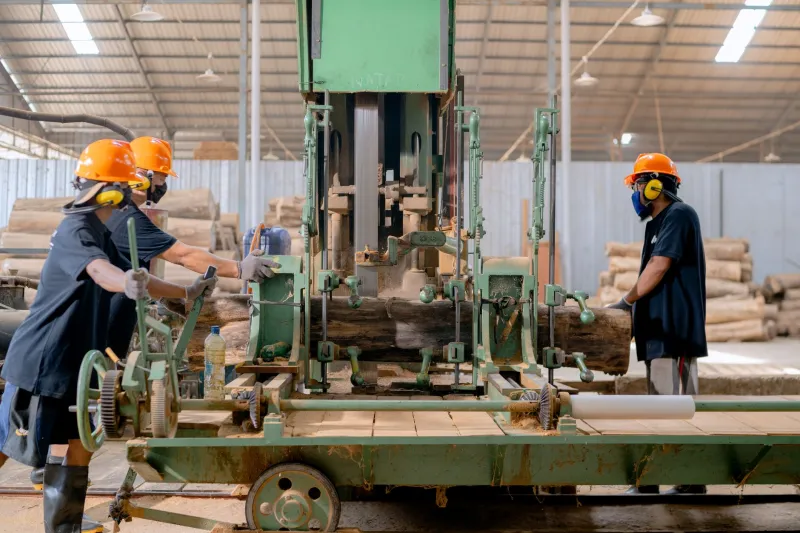
Contemporary sawmill technology, for instance, has advanced considerably in areas such as scanning and optimization software, cutting precision, and automated material handling. A modern curve-sawing gang or optimized edger line can recover meaningfully more fiber value per log than equipment designed to earlier tolerances. In a business where lumber recovery factors directly determine revenue yield from a fixed raw material input, that gap compounds across every shift, every week, and every season.
Consider a hypothetical mid-size softwood mill processing 150 million board feet annually. A conservative one-percent improvement in lumber recovery—well within the capability differential between 15-year-old and current-generation equipment—translates to 1.5 million additional board feet per year. At prevailing lumber prices, that figure can represent hundreds of thousands of dollars in recovered revenue that the operation is currently leaving on the floor.
Energy consumption presents a parallel opportunity. Older motors, hydraulic systems, and kiln configurations routinely operate at efficiencies that modern variable-frequency drives and heat recovery systems can dramatically improve. With industrial energy costs remaining elevated across most US timber-producing regions, the operating cost differential between legacy and current-generation equipment has widened considerably in recent years.
Why Operators Delay: Unpacking the Behavioral and Financial Barriers
Understanding why rational operators continue to defer replacement decisions requires examining both the psychological and structural pressures they face.
On the behavioral side, loss aversion plays a significant role. Capital equipment replacement requires a large, visible cash outlay—one that appears on the capital budget and demands board-level justification. The costs of continued operation, by contrast, are diffuse, incremental, and often absorbed into operating expense lines without triggering equivalent scrutiny. The pain of the known (a maintenance invoice) consistently feels more manageable than the pain of the uncertain (a major capital commitment with a multi-year payback horizon).
Structurally, access to capital remains a genuine constraint for many independent mill operators. Equipment financing markets have tightened since the interest rate environment shifted in 2022 and 2023, and lenders applying traditional underwriting criteria to timber operations—a sector with inherent cyclicality—frequently demand terms that make replacement economics less compelling than a simple NPV analysis might suggest.
There is also the operational disruption factor. Installing and commissioning a new primary breakdown line or a replacement dry kiln system requires downtime, retraining, and a period of reduced throughput as the crew adapts. For operations running at or near capacity, scheduling that disruption is genuinely difficult—and the temptation to defer until a slower period is understandable, even when that slower period never quite materializes.
A Framework for Making the Decision
Given these competing pressures, enterprise decision-makers need a structured approach to evaluating equipment lifecycle decisions—one that moves beyond gut instinct and incomplete cost data.
Step one is establishing a full total cost of ownership (TCO) baseline for each major asset. This means aggregating maintenance expenditures, energy costs, production losses from downtime, and quality-related waste attributable to equipment performance, then expressing that figure as an annualized cost per unit of output.
Step two is benchmarking that TCO against the projected operating cost profile of a replacement asset. Equipment manufacturers and independent consultants can typically provide modeled performance data for modern alternatives, though operators should apply conservative assumptions and validate claims against reference sites where possible.
Step three is evaluating the retrofit option honestly. In some cases—particularly for equipment with sound structural frames but outdated control systems or worn drive components—a targeted modernization investment can extend useful life and close a meaningful portion of the performance gap at a fraction of full replacement cost. The key is ensuring that the retrofit scope is genuinely addressing the primary performance deficits, not simply deferring the inevitable.
Step four is stress-testing the replacement case across multiple scenarios, including downside lumber price environments. A capital investment that pencils out at current prices but becomes deeply problematic if markets soften by 20 percent deserves additional scrutiny before commitment.
The Strategic Dimension
Beyond the individual asset economics, mill modernization carries a strategic dimension that enterprise operators should weigh carefully. Operations running current-generation equipment are better positioned to attract and retain skilled technicians, who increasingly prefer working with advanced control systems over aging mechanical platforms. They are also better placed to meet evolving customer quality specifications, comply with tightening environmental and emissions standards, and adapt to future automation integration.
The timber industry's competitive landscape is not standing still. Regional and national producers who have made consistent, disciplined capital investments over the past decade are processing more fiber with fewer inputs than their peers who have deferred. That gap, once established, is difficult to close.
For mill operators still running on rust, the most important first step is clarity—a rigorous, honest accounting of what that aging equipment is actually costing the business each year. The number, once surfaced, has a way of making the replacement conversation considerably easier to begin.