The Invisible Line Item: Why Extreme Weather Is Rewriting the Forestry Enterprise Risk Playbook
For most of the twentieth century, weather was a backdrop variable in timber enterprise planning — something that influenced harvest timing and occasionally disrupted logistics, but rarely threatened the fundamental economics of a forest operation. That assumption no longer holds. Across the American West, Southeast, and Great Lakes regions, extreme weather events are escalating in frequency and severity in ways that demand a fundamental rethink of how forestry enterprises model risk, structure insurance, and allocate capital across their land portfolios.
This is not an environmental argument. It is a financial one. The question facing enterprise decision-makers is not whether climate variability will affect their operations — it already is — but whether their organizations are structured to absorb that variability without catastrophic P&L consequences.
What the Loss Data Is Actually Telling Us
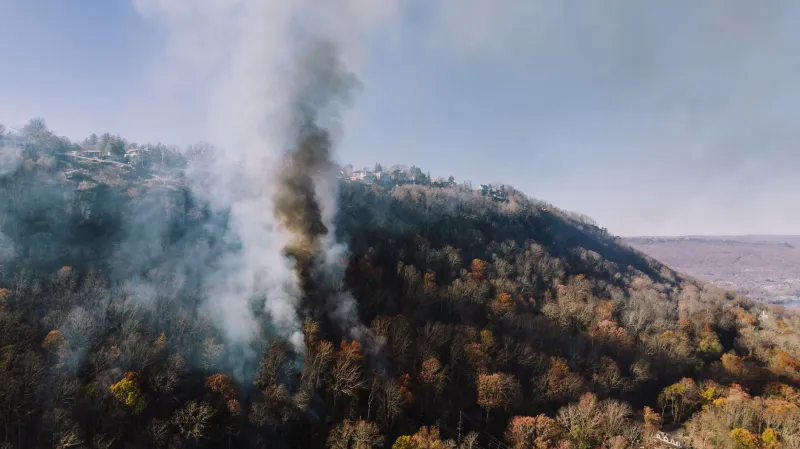
The scale of weather-related timber losses in recent years is difficult to dismiss. The 2020 wildfire season alone destroyed an estimated 10 million acres across western states, with timber losses running into the billions of dollars. Successive drought cycles across the Pacific Northwest and Northern Rockies have stressed tree health, elevated beetle infestation risk, and depressed long-term yield projections in regions that were once considered among the most productive softwood timberlands in North America.
In the Southeast, hurricane frequency and intensity have produced episodic but devastating blowdown events. Hurricane Michael's 2018 landfall in the Florida Panhandle destroyed an estimated 2.8 million acres of commercial timberland — a loss that reverberated through regional supply chains for years. More recently, atmospheric river events and ice storms have disrupted harvest and transportation operations in ways that compress margins even when standing timber survives intact.
What makes these events particularly challenging from an enterprise management perspective is their compounding nature. A drought that stresses a timber stand does not produce an immediate visible loss — it creates latent vulnerability that manifests two or three years later in the form of pest outbreaks, disease pressure, or reduced growth rates. By the time the financial impact registers, the causal chain is difficult to trace and even harder to insure against retroactively.
Insurance Markets Are Responding — Unevenly
The US timber insurance market is in a period of significant transition. Parametric insurance products — which pay out based on measurable trigger events such as rainfall deficits, temperature thresholds, or wind speed readings rather than assessed losses — are gaining traction among larger forestry enterprises as a complement to traditional forest property coverage. The appeal is speed: parametric policies can generate payouts within weeks of a trigger event, providing liquidity at precisely the moment an operation needs it most.
However, the market for parametric timber products remains relatively thin outside of the largest institutional timberland owners. For mid-market enterprises, the more immediate challenge is the tightening of conventional forest property insurance terms. Several major insurers have restricted coverage in high-wildfire-risk zones across California, Oregon, and Washington, leaving some operations with materially higher deductibles, reduced replacement value coverage, or — in the most exposed areas — no viable coverage at all.
This coverage gap is not hypothetical. It is a present operational reality that some western timber enterprises are managing by self-insuring portions of their risk exposure, a strategy that requires substantial capital reserves and a sophisticated understanding of probability-weighted loss scenarios. For enterprises that lack that capital depth, the exposure is simply unhedged.
Portfolio Diversification as a Climate Strategy
One of the more consequential shifts in enterprise forestry thinking involves treating geographic and species diversification as a climate resilience tool rather than purely a growth strategy. The logic is straightforward: a portfolio concentrated in a single region or a single species faces correlated climate risk. A drought that devastates a ponderosa pine operation in eastern Oregon does not affect a loblolly pine plantation in Georgia — and vice versa when a Gulf Coast hurricane season intensifies.
Some of the larger institutional timberland investment management organizations (TIMOs) have been applying this framework for years, but it is increasingly relevant to family-owned and mid-market enterprises that have historically maintained more geographically concentrated holdings. Acquiring or partnering in timberlands across multiple climate zones is not a trivial undertaking, but the risk-adjusted case for diversification has strengthened considerably as regional weather volatility has increased.
Species diversification within a given property is a parallel strategy. Mixed-species stands tend to demonstrate greater resilience to pest pressure and disease than monoculture plantations, and they often recover more effectively from weather disturbance. The trade-off is typically lower near-term yield efficiency — a cost that enterprise managers need to weigh explicitly against the long-term risk reduction benefit.
Operational Adaptation: From Reactive to Anticipatory
The most resilient forestry operations are those that have moved from reactive weather management to anticipatory planning. In practical terms, this means integrating climate projection data — including regional temperature trend models, precipitation forecasts, and fire risk indices — into harvest scheduling, stand management decisions, and capital investment timing.
Several US Forest Service and university extension programs now offer regionally specific climate adaptation planning resources tailored to commercial forestry operations. These tools are underutilized by the private sector, in part because the connection between long-range climate modeling and near-term operational decisions is not always intuitive. Building that analytical capacity — whether in-house or through specialist consultants — is increasingly a competitive differentiator.
Harvest acceleration in at-risk stands is another adaptation tactic gaining acceptance. When climate models and on-the-ground monitoring suggest elevated risk in a particular area, bringing forward harvest schedules to capture timber value before a potential loss event is a defensible financial strategy. It requires flexibility in processing and marketing infrastructure, but operations that have built that flexibility are better positioned to act on risk intelligence when it matters.
The Broader Imperative
There is a temptation in enterprise risk management to treat extreme weather as an external variable — something that happens to a business rather than something a business can systematically prepare for. That framing is becoming untenable. Climate variability is now embedded in the long-term economics of US timber enterprise, and the organizations that thrive over the next two decades will be those that treat it as a first-order strategic consideration rather than an asterisk in the annual risk register.
The infrastructure for that response — better insurance products, portfolio diversification frameworks, operational adaptation protocols — exists and is maturing. The remaining variable is organizational will: the commitment to invest in resilience before a catastrophic event makes the investment feel urgent. In forestry, as in forest management itself, the best time to prepare for disruption is before it arrives.